
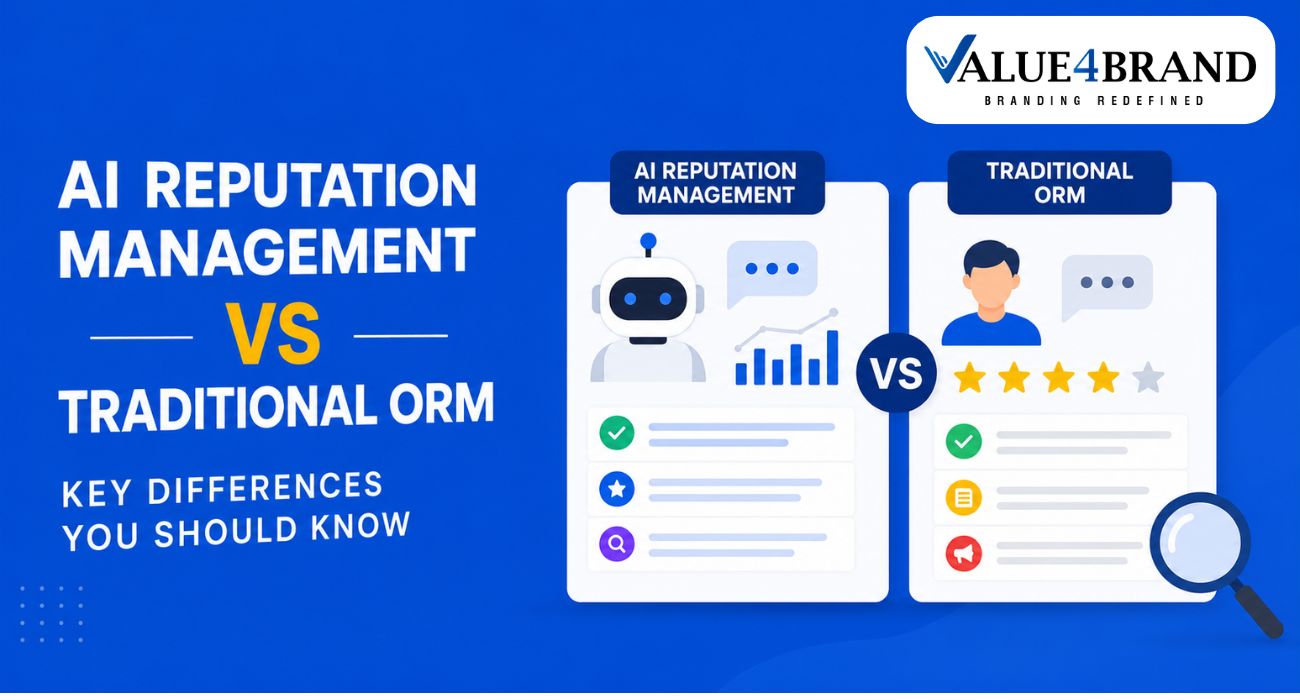
Traditional and AI reputation management mainly differ due to their focus area. The older approach deals with handling results across search engines and customer reviews. The new practice is more concentrated on how artificial intelligence generative tools, like Gemini and ChatGPT, shape citations and narratives while answering user queries.

Reach out to us anytime — we’re just a message away !!
We’d love to hear from you! Whether you have a question, feedback, or just want to say hello, our team is here to help.
Schedule a CallBeyond this, there are several factors that help understand the differences between both practices. Going through these is important for identifying when to carry out traditional or AI ORM to protect an individual or brand’s digital presence across situations.
What is AI Reputation Management?
AI reputation management is a practice that includes monitoring, improving, and maintaining perceptions regarding an individual, a business, or an organization in artificial intelligence-powered search systems. ChatGPT, Google AI Overviews, and Gemini are some examples of these systems.
What is Traditional Online Reputation Management?
Traditional online reputation management or ORM is a process that involves monitoring and enhancing the presence of a brand, person, or company across digital channels. These channels can comprise search engine results, blogs, review platforms, news coverage, digital forums, and social media.
Traditional vs. AI Reputation Management: 4 Main Differences to Look at
AI online reputation management and traditional ORM can be distinguished in their objectives, sole focus, practices, and platforms. While the former approach is more concentrated on public perceptions online, the latter focuses on how artificial intelligence systems present brands or businesses.
In all, there are 4 factors that help differentiate both approaches.
Goals to Achieve
Traditional and AI ORM differ in terms of the goals that can be attained through each practice. The former approach is mainly about building trust, alongside maintaining a positive digital presence. It is used by businesses to ensure better customer perceptions. For this, their reputation amidst situations like crises is protected. Besides, confidence among partners, customers, and investors is built.
AI ORM’s core goal is to influence how artificial intelligence systems present a brand when online users ask specific questions. The focus is on generating positive answers or summaries. According to Value4Brand, the leading company for ORM services in India, when these are generated, they should favorably reflect correct, trustworthy, and up-to-date details.
Main Area of Focus
The traditional approach to reputation management is different from the practice driven by artificial intelligence systems in terms of the main focus area.
Essentially, the focus of the older approach concentrates on search engine results, news, customers’ reviews, social media discussions, blogs, etc. It involves monitoring the associated platforms to assess public sentiment. Then it improves users’ perceptions across the internet.
AI-powered reputation management focuses on the details that artificial intelligence systems use when they generate summaries, answers, as well as recommendations. Beyond public conversations, this practice emphasizes the authority, accuracy, credibility, and consistency of content.
Types of Practices
AI reputation management is inclusive of practices like sharing updated and reliable content when online users look for it. It strengthens visibility in trustworthy sources in order to maintain correct business information and prevent misleading or factually inaccurate details as much as possible.
Unlike this practice, traditional ORM works through review handling, managing customer complaints, posting positive news articles or blogs, and generating favorable social media engagement that improves SEO or search engine optimization. Through these practices, search visibility gets better.
Platforms in Use
Traditionally, online reputation management has been carried out through review posting sites, business blogs, digital forums, and news portals. Additionally, social media platforms like Facebook, Instagram, X (Twitter), and LinkedIn come into use. Note that these are websites across which users actively share their experiences and opinions.
On the other hand, AI ORM is executed through artificial intelligence-powered search and answer platforms like Gemini, ChatGPT, and other generative AI tools. This practice is dependent on brand pages, authoritative websites, trusted knowledge sources, and digital publications. Through these, the respective systems cite details to produce answers in response to users’ queries.
Which is Better for Your Brand: AI or Traditional ORM?
Both traditional and AI reputation management can be effective for a brand. But these approaches work impactfully in different scenarios. The older one is often preferable when businesses have to manage online perceptions directly. However, AI ORM is more reliable when buyers depend on AI-generated answers prior to making decisions.
| Traditional ORM | AI ORM |
| This practice should be used when there is a reputation crisis and customers post bad reviews. | This approach is less effective amidst public crises as AI systems may largely reflect existing discussions. |
| It should be put into use in case a brand needs to directly respond to customer complaints and reviews online. | It is better when direct interactions with shoppers is not the core area of focus within a scenario. |
| A business should rely on it to improve Google search results as well as online public sentiment. | One should exercise AI ORM services to enhance how artificial intelligence tools describe brands in their answers and summaries. |
Thus, not one but both practices for managing online reputation are useful for companies, provided that they know which one to carry out in a specific situation.
Endnote
AI and traditional reputation management are different approaches but both are equally important. The former practice protects public perceptions online whereas the new approach shapes how artificial intelligence systems present a company. Once this difference is understood, they should be practiced within particular scenarios for the maximum impact.
Frequently Asked Questions
Q1. What happens if ChatGPT gives negative information about my brand?
A negative AI response can influence how potential customers perceive your business. The first step is to identify whether the information is inaccurate, outdated, or based on legitimate negative coverage. AI reputation management then focuses on strengthening credible sources and correcting factual gaps that may contribute to the response.
Q2. Can a business control what ChatGPT or Gemini says about it?
No business can guarantee or directly control an AI platform’s response. However, businesses can influence the information ecosystem that AI systems may rely on by building authoritative content, maintaining consistent information, and earning credible third-party coverage.
Q3. Why does my brand appear differently on ChatGPT and Google?
Search engines and generative AI systems process information differently. Google primarily presents ranked webpages, while AI systems may synthesize information from multiple sources to generate an answer. As a result, a brand can have strong Google visibility but still receive incomplete or inconsistent AI-generated descriptions.
Q4. Can AI search results damage a company’s online reputation?
Yes. If an AI system repeatedly presents outdated, inaccurate, or negative information about a company, it can affect user trust and purchasing decisions. This is why monitoring AI-generated brand responses is becoming an important part of modern reputation management.
Q5. How can I find out what AI says about my company?
Search your company name, products, services, executives, and important brand-related questions across multiple AI platforms. Compare the responses for accuracy, sentiment, sources, citations, and recommendations. Repeating these checks periodically can help identify changes in your AI reputation.
Q6. Does having a good Google ranking mean my AI reputation is also good?
Not necessarily. Strong Google rankings can support your overall digital authority, but AI platforms consider and synthesize information differently. A brand can rank well in traditional search while still being poorly represented, overlooked, or described incorrectly in AI-generated answers.
Q7. Can AI reputation management help my brand get recommended by AI?
It can help improve the digital signals and information ecosystem surrounding a brand, but it cannot guarantee an AI recommendation. Building authoritative content, credible third-party mentions, consistent information, and a trustworthy online presence can increase the chances of being represented accurately.
Q8. Is AI reputation management only useful for large companies?
No. Small businesses, startups, professionals, and local companies can also benefit. If potential customers use AI tools to compare businesses or ask for recommendations, the way those systems represent the brand can directly affect consideration and trust.
Q9. What should I do if an AI platform cites an unreliable website about my business?
First, verify the claim and identify the source being cited. If the information is inaccurate, focus on establishing stronger and more authoritative sources containing the correct information. You can also address the original inaccurate information where appropriate rather than simply trying to suppress the AI response.
Q10. Is AI reputation management the future of online reputation management?
AI reputation management is likely to become an increasingly important part of ORM as more people use AI-powered search and answer platforms to research businesses. However, it is unlikely to completely replace traditional ORM. The strongest strategy combines traditional reputation management with AI-focused monitoring and optimization.