
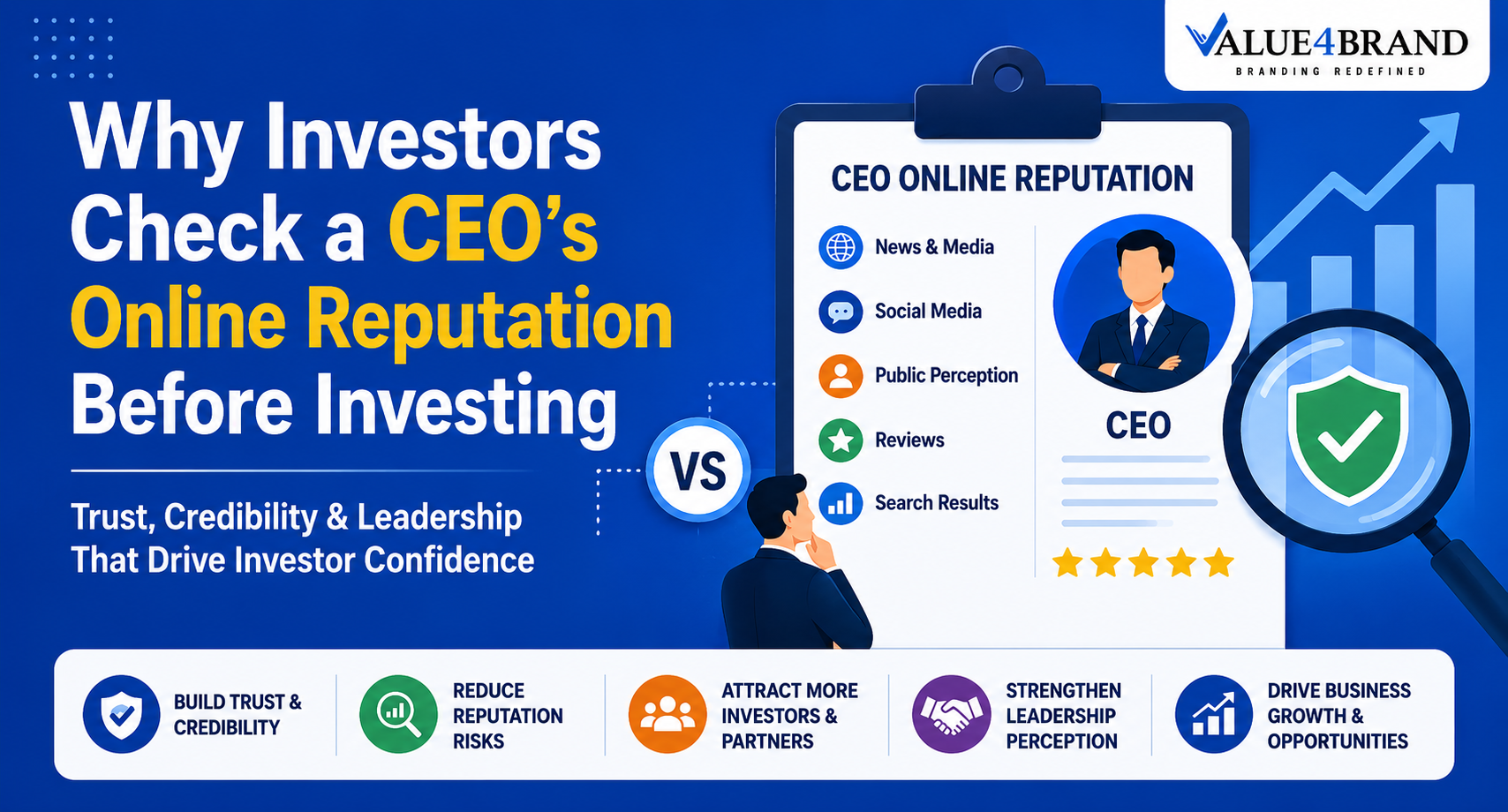
How a brand performs in the market and its online presence are no longer the only factors that investors consider before making investment decisions. CEO online reputation is as important as these, when it comes to forming their impressions about a business. They often research the kind of leadership behind it to understand whether the associated figure is credible, professional, accountable, and responsible.

Reach out to us anytime — we’re just a message away !!
We’d love to hear from you! Whether you have a question, feedback, or just want to say hello, our team is here to help.
Schedule a CallChief executive officers with a strong digital image can facilitate investors’ confidence. The impact of this aspect is such that attributes like credibility and trust are clearly presented. With the use of online reputation management (ORM) for CEOs, it is easier to fulfill this goal. As they attract more stakeholders, they can derive more opportunities and profits for their brands in the future.
Should CEOs Care About their Online Reputation?
For certain, CEOs should care about their presence online as it can influence the perceptions of investors, partners, as well as employees. In most cases, they read about chief executive officers over the web prior to making business decisions. This helps in finding the information they need to shape their trust.
Why Do Investors Check a CEO’s Online Reputation?
Investors check a CEO’s online reputation for understanding whether he or she seems credible and professional. Public interviews, social media presence, articles, and the results across search engines can indicate the person’s industry expertise as well as the overall perception. When the figure is credible, she or he can strengthen the confidence of investors before making any financial discussions.
Understanding Reputation Risks
An investor often conducts online research to detect potential risks to CEO reputation long before investments are made. Any ethical issues, negative news in media coverage, legal disputes, or public criticism can reflect business risks early. The sooner they are identified, the faster they help investors assess whether his or her brand can face reputation-related challenges in the future.
Evaluating the Associated Business
CEOs’ personal branding can shape decision-making after finding out how favorable their businesses are. Investing companies may go through public statements, announcements in the past, media interviews, etc., to understand the approach to handling growth, managing challenges, and winning strategic opportunities.
In addition, when communication is consistent and meaningful, it can lead to stronger judgment, even when certain concerns may arise due to controversial statements.
Measuring CEOs’ Transparency and Accountability
The online behavior of chief executive officers of brands can tell the extent to which they are transparent and accountable. Stakeholders often prefer on-time responses, clear communication, and the willingness to provide solutions when customer concerns arise. When leaders demonstrate these attributes, they may inspire investors to confide in CEO online reputation.
Understanding Market and Public Perception
Investors can study discussions across online forums to gain insights into how buyers, employees, and the media form their perceptions about a specific brand’s CEO. The public sentiment linked to him/her can impact that brand’s reputation as well. Besides, it can foster consumers’ trust along with market confidence.
Take into account that a leader who is largely respected in the digital space can contribute positively to the overall perception for a venture, thereby meeting investors’ expectations.
Why is Online Reputation Management Important for CEOs?
In recent years, online reputation management for CEOs is important because investors frequently build their opinions about respective businesses due to their leadership. When search results related to such figures show up, the impact of this process can help them learn about their professional achievements, consumer relationships, and credibility.
In this regard, other important reasons include:
- ORM for CEOs establishes credibility with buyers and business partners.
- It strengthens the trust of the public in the leadership of the company.
- This practice facilitates fundraising, investment, and partnership opportunities.
- It helps in managing negative publicity and controlling misinformation.
- This process enhances visibility across search engines and AI-driven summaries.
- Moreover, it can attract advisors, talent, and industry-relevant collaborators.
An Overview of ORM for Chief Executive Officers
CEO online reputation management is the practice of handling and improving how a chief executive officer is perceived online. It maintains or enhances their image across search engines, news platforms, social media, and AI-generated search results.
It helps ensure that the information users find about these figures is positive, accurate, trustworthy, and in sync with brand values.
Impact of CEO Online Reputation Management on Investors
A regularly managed digital reputation can favorably impact how investors assess a company based on the reputation of CEOs. Also, it serves a key role in assessing the future opportunities associated with their brands. When chief executive officers consistently show their industry-specific knowledge and maintain cordial terms with users, prospects, or customers, they attract more investments.
Owing to strong personal branding, the impact of ORM is broader as it addresses various challenges such as:
- Outdated profiles of CEOs in search results.
- Unanswered or unresolved public concerns that can affect investors’ perceptions.
- Negative business information online.
- A lack of leadership communication.
- Misleading data across online mentions.
- Difficulty in distinguishing authentic information.
- Bad or poor search results that can dominate branded queries.
- Inaccuracy across AI-generated summaries about such public figures.
All in All,
Investors increasingly evaluate a company’s image as well as its CEO. Solid online reputation can help them trust their final decision to invest in its products or services. Through personal branding approaches like reputation management, they can actively build positive perceptions that invite more stakeholders.
Frequently Asked Questions
Q1. Why is CEO online reputation important for investors?
A CEO’s online reputation can influence how investors assess leadership credibility, transparency, expertise, and potential business risks before making an investment decision.
Q2. What is CEO online reputation management?
CEO online reputation management is the process of monitoring, managing, and improving how a chief executive is represented across search engines, news websites, social media, business platforms, and AI-powered search results.
Q3. How does a CEO’s reputation affect a company’s reputation?
A CEO is often closely associated with the company they lead. Positive leadership perceptions can strengthen trust in the business, while negative publicity surrounding a CEO can potentially affect stakeholder confidence and the company’s overall reputation.
Q4. How do investors research a CEO before investing?
Investors may review Google search results, news coverage, professional profiles, interviews, social media activity, public statements, industry discussions, and other credible sources to understand a CEO’s background and reputation.
Q5. What can damage a CEO’s online reputation?
Negative news coverage, controversial statements, legal disputes, misleading information, unresolved public complaints, inappropriate social media activity, outdated profiles, and negative search results can all create reputation risks for a CEO.
Q6. How can CEOs improve their online reputation?
CEOs can improve their online reputation by maintaining accurate profiles, publishing expert content, building a credible personal brand, monitoring search results, addressing legitimate concerns professionally, and developing a consistent presence across trusted digital platforms.
Q7. What is executive reputation management?
Executive reputation management is a specialized form of online reputation management focused on protecting and strengthening the digital reputation of CEOs, founders, executives, and other senior business leaders.
Q8. Can a CEO’s personal brand influence investor confidence?
Yes. A CEO’s personal brand can contribute to perceptions of expertise, leadership, transparency, and credibility. A consistent and professional digital presence can help establish greater confidence among investors and other stakeholders.
Q9. How can CEOs manage negative search results?
CEOs can start by identifying the source and accuracy of negative results, addressing legitimate issues where appropriate, publishing authoritative and useful content, strengthening credible third-party coverage, and consistently building a trustworthy digital presence.
Q10. How does AI search affect a CEO’s online reputation?
AI-powered platforms can summarize information about CEOs when users ask questions about their background, leadership, or reputation. Maintaining accurate, credible, and consistent information across authoritative sources can therefore become an important part of modern CEO reputation management.
Related Articles
AI Reputation Management vs. Traditional ORM: What’s the Difference?
Why ORM is Critical for CEOs, Founders, and Public Figures?
Personal Branding vs Reputation Management: Which Matters More?
Why Your Personal Reputation Online Directly Affects Your Business Growth